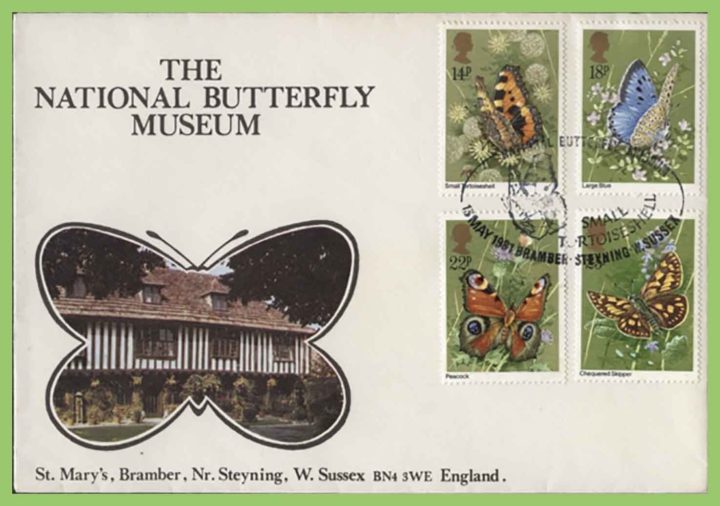
This postcard dates from 1981. St. Mary’s is a late 15th-century house with extensive gardens, which has been owned by various notable people including the Hon. Algernon Bourke, one-time owner of White’s gentleman’s club in St. James’s, London. Bourke and his wife are said to be the inspiration for characters in Oscar Wilde’s play, The Importance of Being Earnest. A more recent owner was Paul Smart, a lepidopterist with a large collection of butterflies.
Smart founded The Saruman Museum in 1970 in private premises in Tunbridge Wells in Kent. The museum moved from there to Beckley near Rye, Sussex, in 1975, and was established at St. Mary’s in March 1980 as the National Butterfly Museum. Smart was an international expert on butterflies, and published an encyclopedia which contained over two thousand species. The ‘National’ in the museum’s title was never an official designation and caused some disquiet amongst Smart’s colleagues. It has been suggested that although the museum was open to the public and had educational displays, it was primarily a butterfly trading agency.
Whether truly a museum or not, it seems not to have been a financial success. Between forty and fifty thousand specimens from the collection were offered for auction at Christie’s in July 1982, with only two lots sold to Glasgow Museums (PDF). The house and contents including the rest of the collections were successfully auctioned at Sotheby’s in October 1983.

Advertisement for The Saruman Museum from The Entomologist’s Record and Journal of Variation, vol. 89, 1977.
For more on the history and contents of the two museums, see: Tennent, W. J., 2005. The ‘National Butterfly Museum’ (Bramber, West Sussex) and dispersal of butterfly ‘type’ material following a Sotheby’s sale in 1983., Entomologist’s Gazette, 56 (1): 13-24.
2 replies on “National Butterfly Museum”
Hello ! Im not sure who will receive this but I have been interested to read about the Butterfly Collection at Bramber in Sussex.
I moved to Brighton in 1979 and remember going to Bramber a number of times to visit the Museum. I also went when we heard that the Museum was closing down as there was actually a sale of the butterflies and we went to this – they pulled out the drawers of the cabinets on request and people were able to choose from the specimens on show, they were being sold separately and they supplied us with old entymologist cardboard collecting boxes to take them away – they were extremely cheap, the specimens also have the dates, names and places from where they had been collected from.
We made a large case to display our collection in which I still have – it’s just been fascinating to find out more about the original collection they came from as I realise remembered very little, being quite young at the time.
Hi Judith, Thanks for sharing this story. It’s always fascinating to hear about what happens to museum collections after they close. Mark